
Hubbard Glacier is the longest tidewater glacier in North America and is located partially in Wrangell-St. Elias National Park. Some Alaska cruise ships travel to Hubbard Glacier via Yukatat Bay and Disenchantment Bay to provide passengers breathtaking views of this advancing glacier.

One tributary of Hubbard Glacier begins at Mt. Logan, the highest mountain in Canada and the second highest peak in North America. When it reaches the Pacific Ocean 76 miles later, it can be up to 40 stories high. Hubbard glacier lies in part between Mount Hubbard and Mount Vancouver. It was named for Gardiner Hubbard, the founder and first president of the National Geographic Society. It was reportedly named in 1890 by Israel Russell, who worked for the US Geological Survey and was sent on an expedition of the area by Hubbard. Russell Fjord was later named in Russell’s honor.
Hubbard Glacier is opposite of most glaciers, in that it advances in a warming climate. Temperature increases result in more precipitation traveling toward the St. Elias Mountains, where it becomes snow. When the ice of Hubbard Glacier from Mt. Logan reaches Disenchantment Bay, it is approximately 400 years old. It takes 400 years for ice to travel the length of the glacier.
Only a portion of the glacier is located in Wrangell-St. Elias National Park, with the rest in Canada. Wrangell-St. Elias contains the largest glacial system in the United States, with nearly 35% of the park’s 13.2 million acres covered by glaciers.
About Tidewater Glaciers
Hubbard is a tidewater glacier. A tidewater glacier is a valley glacier that flows all the way to the ocean. Tidewater glaciers are known for their recurring periods of advance and retreat. They are typically less stable than mountain glaciers, because calving glaciers lose their ice faster than glaciers which are just melting. However, they can experience periods of stability as well.
About Yukatat Bay
This 18 mile wide waterway stretches from Disenchantment Bay on its north to the Gulf of Alaska. Cruise ships traveling to Hubbard Glacier pass through Yukatat Bay. The city of Yakutat, known as the first Alaska town with a surf shop, sits in the northern reaches of the Inside Passage. It sits more than 300 miles east of Seward and more than 200 miles northwest of Juneau.
About Disenchantment Bay
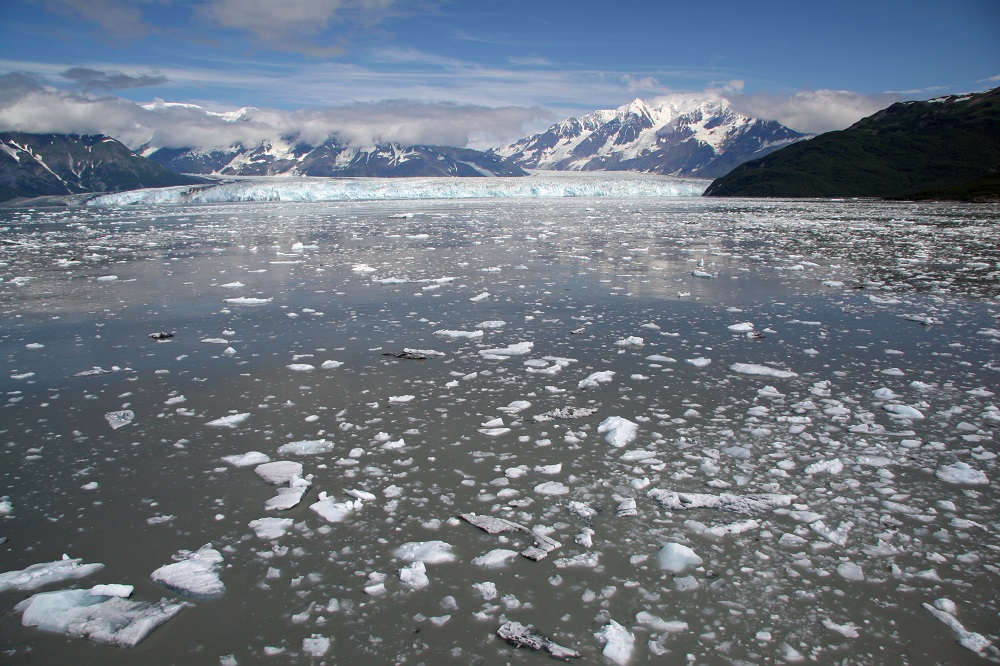
This waterway extends for ten miles from the head of Yakutat Bay at Point Latouche to the mouth of the Russell Fjord. It is the terminus of Hubbard Glacier. It was named by Alessandro Malaspina in 1792 when he discovered that it was not the Northwest Passage.
Hubbard Glacier Cruises
Hubbard Glacier is located on many Alaska cruise itineraries . It does not face the same restrictions as Glacier Bay National Park, which restricts travel inside Glacier Bay to only two cruise ships a day. The path to Hubbard however may be blocked by ice when it is cold so some passengers may only get to see it from a distance.
Hubbard Glacier can be seen from more than 30 miles away as cruise ships enter Yakutat Bay. The face of the glacier is more six miles wide at Disenchantment Bay. Some Hubbard Glacier cruise passengers may be lucky enough to see calving, which is the process of a portion of the glacier breaking off and falling into the sea.

Cruise passengers going to Alaska often face a choice between Hubbard Glacier vs Glacier Bay. Cruise ships spend about nine hours or so sailing inside Glacier Bay and allow passengers to see multiple glaciers. Hubbard on the other hand is a much shorter stay and is a single glacier – though it is unique in that it is advancing and it’s enormous size makes it memorable.